

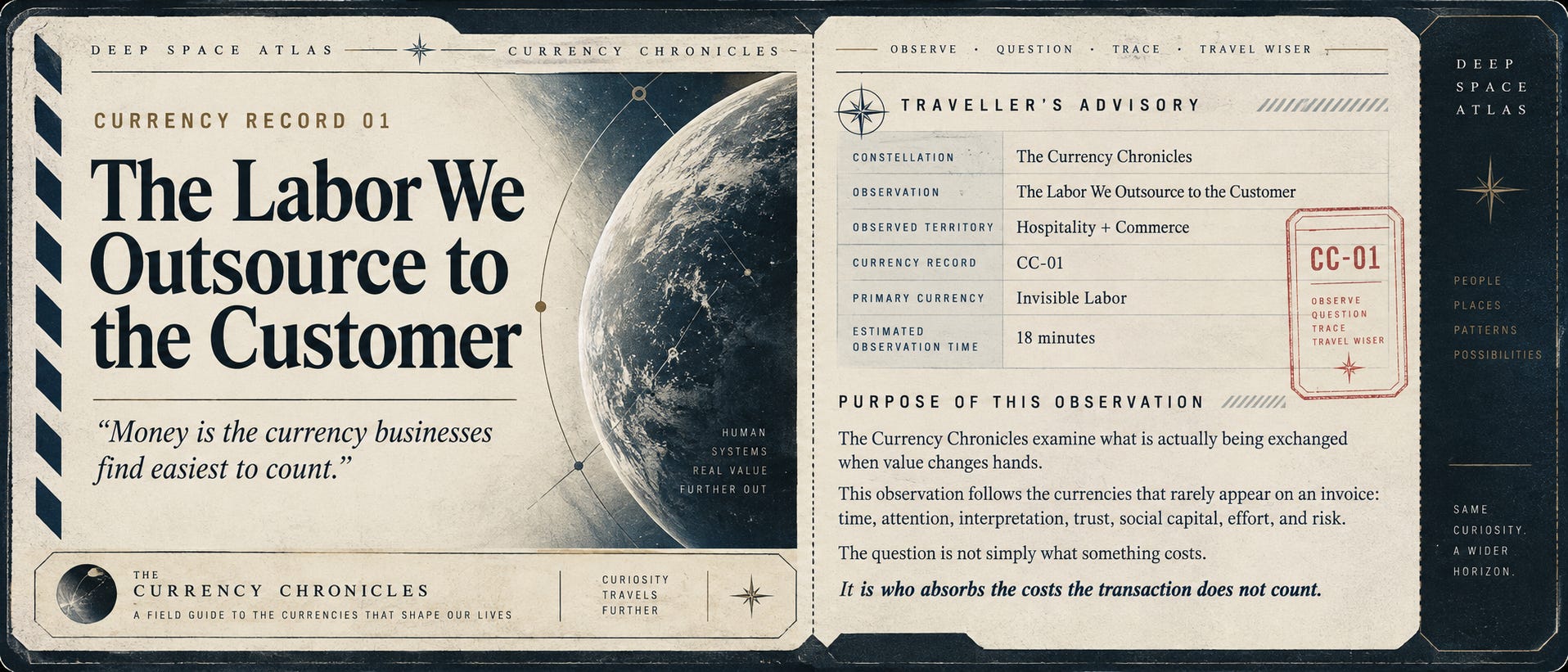
Current Exchange Rate
Highly Valued
• Anticipation
• Legibility
• Trust
• Consideration
• Human coherence
Frequently Externalized
• Navigation
• Interpretation
• Uncertainty
• Risk
• Compensatory labor
Local Customs
Travellers entering this territory may notice:
• A functioning component does not guarantee a coherent experience.
• Money is rarely the only currency changing hands.
• Participation and compensation are not the same kind of labor.
• Hospitality often appears before the customer does.
• Some of the smallest frictions reveal the largest architecture.
Border Advisory
Modern travellers are accustomed to judging whether a business works.
That question may not survive entry.
Watch instead for what the human being must supply to make the experience cohere—and whether that effort properly belongs to them.
A business can work without working for the human being inside it.
Observation Log
For those of you who have been around for a minute, what follows will grant you a deeper look at the structure underlying what I have been tinkering with and turning over the last few weeks. And for anyone new here, you’ll get a summary of the full spectrum of this phenomenon as it would appear perhaps in your own life.
I don’t particularly care whether the pizza was four stars or five.
It’s the moment I couldn’t figure out where to stand that I’m still thinking about.
Or how the employee had to explain why the seasonal flavor they were advertising wasn’t actually available.
Or when we were successfully greeted, seated and given chips—and then somehow disappeared from the operational consciousness of the business for forty-plus minutes.
Or the workshop where the materials were there, the people were lovely, and somehow the home-cooked meal felt more thoughtfully composed than the workshop we’d actually come for.
These are tiny things.
But I’ve realized I have an unusually difficult time not noticing them.
And more importantly, I notice how they relate:
The website changes what I expect from the room.
The room changes what I expect from the service.
The price changes what I expect from the experience.
The signage changes what I expect to be available.
A business can have excellent individual components and still leave the customer performing the invisible labor required to make them cohere.
Once I started noticing it in small transactions, I began seeing it in much larger ones.
At the pizza restaurant, the branding, smell and visual environment had already created an expectation before I’d ordered anything. But there was no obvious queue. The beverage selection seemed strangely narrow relative to both the aesthetic promise and the likely clientele. When we finished eating, I couldn’t determine whether we were expected to clear our own table. Assuming we were, doing so required carrying everything back through an ambiguously organized dining room.
None of this made the restaurant bad.
It made me work.
No, not very hard, and no, this is not labor anyone would reasonably complain about. It is merely a succession of tiny decisions the business has declined—or forgotten—to make on the customer’s behalf.
Every unanswered question transfers a microscopic amount of organizational labor across the counter. Most of us simply perform it.
And then we call the experience “fine.”
At a chocolate shop, I encountered the same phenomenon.
A sign advertised a seasonal flavor. I asked to sample it.
“Well, yes, we have it. It’s the seasonal flavor. But we don’t actually have it. Like, we usually have it, but not right now.”
The employee wasn’t failing. She was performing the labor required to reconcile the business’s own contradictory information.
The sign promised one reality.
Inventory presented another.
The employee translated between them.
I interpreted the translation.
All because nobody had removed a simple countertop sign.
We often to think improving an experience means adding something.
Sometimes improvement is removing the sign.
I’ve experienced the inverse problem, too.
Once, at a restaurant, I was greeted, seated on the patio and given chips and salsa. And then nobody came back.
We ate the chips. We waited.
Eventually, after approximately half an hour without drinks, silverware or a server, we got up and left.
Nobody noticed.
Somewhere between those successful actions, responsibility disappeared. The system contained functioning components and still completely failed the human beings moving between them.
Here’s where I realized the limitations of measuring businesses component by component. Every component can report success while the human being carrying the experience quietly absorbs whatever fell between them.
And sometimes what falls between them is considerably more consequential than a missing server.
Recently I brought several women from my community to an Art of Tea workshop.
I had understood the invitation to mean that we would enter an intimate garden-apothecary environment, learn something about the craft of tea, practice it, and leave having crossed some small threshold of competence.
Instead, the experience amounted to little more than abstract finger-painting.
My sensitivity here probably comes from teaching pottery.
Someone can enter a pottery workshop knowing absolutely nothing about clay. A few hours later, she doesn’t need to be a potter… but she can hold a bowl. Instruction becomes action becomes object becomes memory.
People don’t necessarily need an impressive outcome. They need a legible one.
I started becoming suspicious of the way we calculate what a customer has actually paid. The women who attended that workshop did not merely exchange an admission price. They exchanged time, travel, attention, preparation, trust. Perhaps childcare. And because I’d invited them, I’d put some of my own social capital on the table, too.
But money is the currency businesses find easiest to count.
Once I started looking at transactions this way, some considerably less charming examples became visible.
So here’s the real tea:
Seasons ago, I entered a high-ticket coaching relationship.
Financial growth was central to the work. My finances were discussed in relation to what I should accomplish, what I could earn, and what the investment would supposedly help make possible. But the actual condition of my finances was not meaningfully incorporated into the intake process before I entered the agreement.
At the time, I was in the process of bankruptcy.
I want to be precise about this because precision matters here: I do not blame the coach for my bankruptcy. I made my own financial decisions. I signed the agreement. I retain responsibility for what I agreed to.
What I couldn’t reconcile was this:
What was the business designed to do when information emerged suggesting that its financial arrangement was no longer sustainable for the person it purported to help?
As new information about my bankruptcy status changed my ability to satisfy the existing fee schedule, I communicated what was happening and asked to renegotiate it. By then, I had already fallen outside the terms of the payment agreement. I raised the possibility that I should remove myself from participation until we could establish terms I could actually honor. What I encountered wasn’t curiosity about the changed conditions.
It was the contract.
The agreement designed to protect the business had become more durable than the circumstances of the human being inside it.
Eventually, I left.
Later came attempts to collect the remaining balance, including one communication involving an attorney’s office. I’m deliberately not litigating here whether that balance was legally enforceable. That’s a different question, and not the point of this demonstration.
What I’m pointing to is the original architecture.
Because the problem did not begin when I could no longer satisfy the agreement.
It began much earlier, when we were deciding what my hesitation meant.
During the closing conversation, I felt the instinct to speak with my husband before making the investment.
That instinct was treated as an objection to overcome. And I allowed it to be overcome.
Again: my decision.
But later, inside the coaching itself, I encountered versions of the same sales philosophy I had experienced in onboarding.
Hesitation could be reframed as fear.
Concern could become scarcity.
Failure to invest could become self-sabotage.
Financial reluctance could become evidence that someone was insufficiently committed to the future she claimed to desire.
None of these interpretations is necessarily false. Fear can prevent us from making good decisions. Scarcity can distort our perception. We often do sabotage the futures we say we want.
But there is another possibility:
Sometimes hesitation is information.
Sometimes the alarm is functioning correctly.
And sometimes “I cannot responsibly afford this” is a financial fact.
The danger begins when a framework becomes so authoritative that it can interpret almost any evidence against the desired decision as further evidence for it.
If I hesitate, I am afraid.
If I object, I am resistant.
If I cannot afford it, I am thinking from scarcity.
If I want to consult someone I trust, I am surrendering my authority.
The framework becomes remarkably difficult to contradict because contradiction itself can be absorbed as proof.
I was also encouraged by the promise that I could generate enough money very quickly to compensate for a substantial portion of what I owed.
I couldn’t.
And it gets weirder.
Because once financial pressure, personal development and identity become entangled, “I cannot responsibly afford this” can begin to sound suspiciously like a failure of belief, integrity or courage.
A financial fact becomes a psychological diagnosis.
And now the client has been assigned another form of labor:
She must determine whether the alarm she feels is wisdom or pathology.
I’m particularly sensitive to this because I’ve survived relationships in which emotional, mental, physical and financial power were not always used cleanly.
I have worked hard not to let those experiences turn openness into cynicism. I still want to trust people. I still want to risk. I still want to enter rooms without assuming that everyone inside them intends to exploit me. It took this experience for me to realize that my willingness is a valuable currency.
And I’ve become considerably more aware of what businesses do with the trust people bring them. Especially businesses that trade explicitly in transformation.
If you sell pizza, the ethical stakes of confusing me about a trash can are fairly low.
If you sell financial growth, psychological transformation, healing, leadership, business development, recovery, confidence, intimacy, spiritual development or personal power, vulnerability may be part of the material you are working with. That changes the standard.
The fact that someone signed something cannot be the only evidence that the transaction served them.
The fact that a sale converted cannot tell us whether it should have.
A completed sale is not proof of a well-made decision.
And a legally defensible business model is not necessarily a humane one.
Two inches beyond legally defensible, we encounter everyone’s favorite buzzword: optimized, and my skin starts to crawl.
Optimization requires a variable, of course. Usually something we can count: conversion, revenue, retention, efficiency. And all of those numbers can improve while the condition of the human being on the other side of them deteriorates. Not because they’re useless, just that metrics rarely capture the whole transaction.
A business can reduce labor internally by transferring it externally. Sometimes that means making the customer navigate or interpret what the business hasn’t made clear. At higher stakes, it can mean transferring financial risk, emotional regulation or strain into the customer’s relationships.
Even the responsibility for determining whether the service is harming the person purchasing it.
But see, the cost did not disappear, it changed currencies. And changed hands.
Which leaves me with a question considerably larger than customer service:
What does your business require the client to absorb in order for your business model to work?
I’ve started thinking that high-ticket may have considerably less to do with expensive materials or “optimization” than with how much has already been considered on your behalf.
Someone making the next step obvious without requiring you to ask what happens next. Nothing particularly extravagant, just a small piece of labor that meant we both understood the assignment.
This is also why I don’t think hospitality is synonymous with friendliness.
Hospitality can be embedded into an intake form, a payment schedule, a cancellation policy, a handoff between employees, the removal of a sign that shouldn’t still be hanging there.
Each of these marks a decision about what the business will carry and what it will leave for the person moving through it.
And I don’t think the goal is to make the client do nothing. A workshop participant should participate. A transformation client should have responsibilities. A customer may still need to choose, learn, practice or ask questions.
Sometimes that labor is precisely where the value lives. For me, the useful distinction is between participation and compensation.
Am I doing this work because it belongs to the experience? Or am I doing it because the business didn’t?
A person learning pottery should have to touch the clay. She shouldn’t have to figure out whether anyone intended to teach her what to do with it. Good social architecture doesn’t necessarily eliminate effort. It becomes more deliberate about whose effort belongs where.
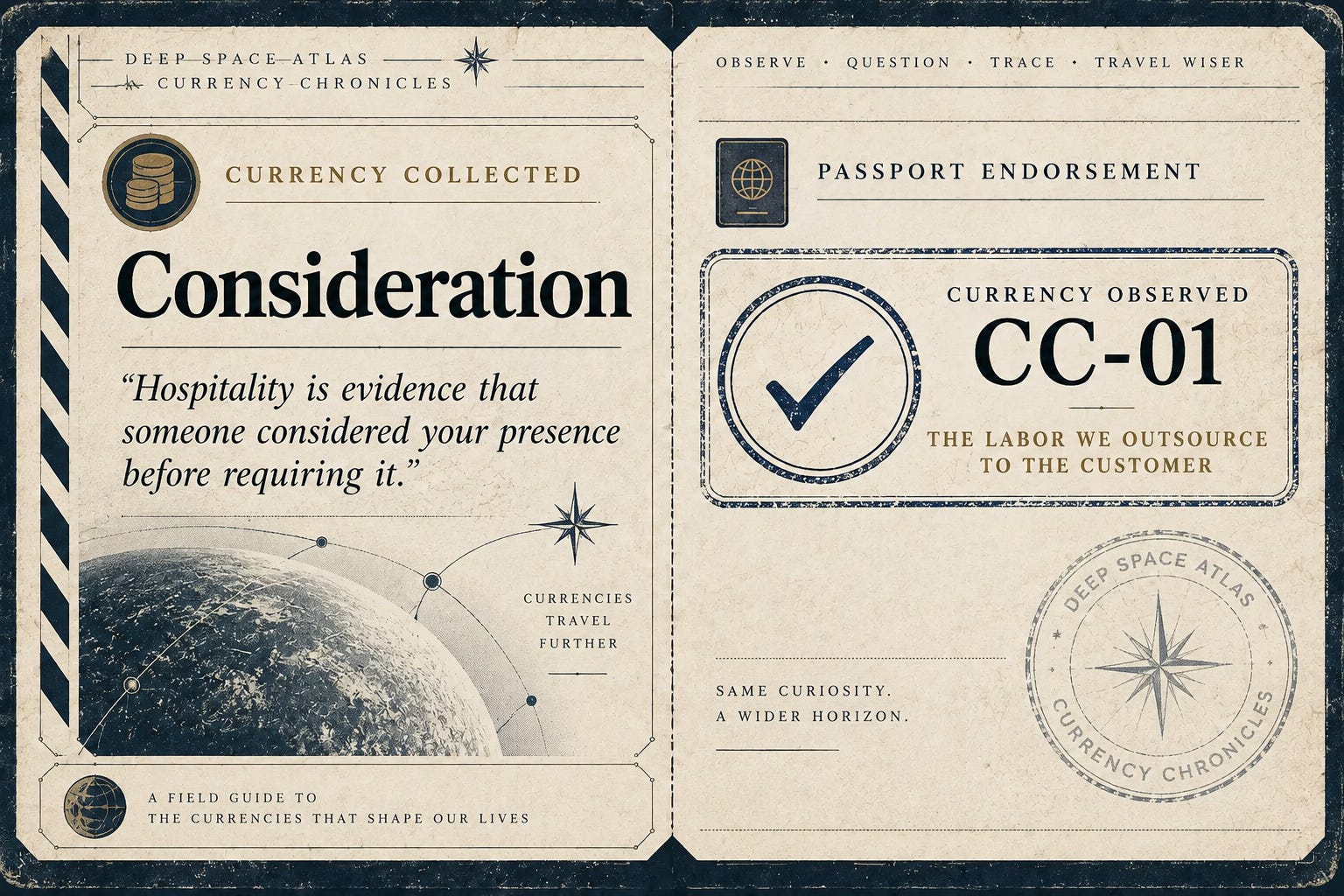
Perhaps that’s what I’ve been reaching for when I use the word hospitality: evidence that someone considered your presence before requiring it.
We can analyze reviews, conversion rates, websites, traffic, copy, workflows, customer behavior, inventory and enormous quantities of feedback at scales no individual person could reasonably process.
Still, there remains entire segments of activity that are harder to track, and they range from things that are too small to make complaints about, all the way through assuming more risk than the provider. And they aren’t necessarily problems that become visible by examining any single component more closely.
Their meaning exists partly in relationship to one another.
Sometimes you have to inhabit an experience long enough to notice what its composition is asking a human being to do. And the person who built it may be uniquely disadvantaged in seeing some of that.
Not because she knows too little about her business.
Because she knows too much.
She already knows which door to use and what happens next. Familiarity has made the intended experience almost impossible for her to unknow.
I don’t imagine that my experience represents some objective human experience. I am one person, arriving with my own history, expectations, body, knowledge and blind spots.
But that is also the point.
I can arrive from the outside and ask whether what you intended to give survived the journey between your understanding and mine.
I’m not interested in evaluating a business from the position of an critic, more than in endorsing that passage between intention and reception. I want the person on the other side considered with the same care I would want extended to my friend, my mother, my grandmother, a stranger, or a child. Not because all of those people would experience the business the way I do. They wouldn’t.
Because none of them should have to already understand the business in order to receive what the business intended to give them.
For years, my work has moved between creative direction, production, art, writing, gatherings and helping other people’s ideas become tangible. From the outside, these can look like different kinds of work. From inside them, I keep doing much the same thing.
I pay attention to what someone intends to make possible, and then to what happens when another person actually encounters it.
Somewhere between the idea and the encounter, the thing being offered either arrives intact—or begins getting lost in translation.
I notice that passage.
Not because I know more about the business than the person who built it. Usually, the opposite is true.
They know the business.
I don’t.
And for a brief period, not knowing is useful. I can encounter what was made before familiarity teaches me how to compensate for it.
Increasingly, I think this is one of the throughlines of my work.
My attention follows what happens when an idea leaves the person who made it and enters a world she can no longer entirely control. What survives the translation? What becomes clearer? What gets distorted?
What requires the recipient to finish making sense of it?
And what arrives more beautifully than anyone planned?
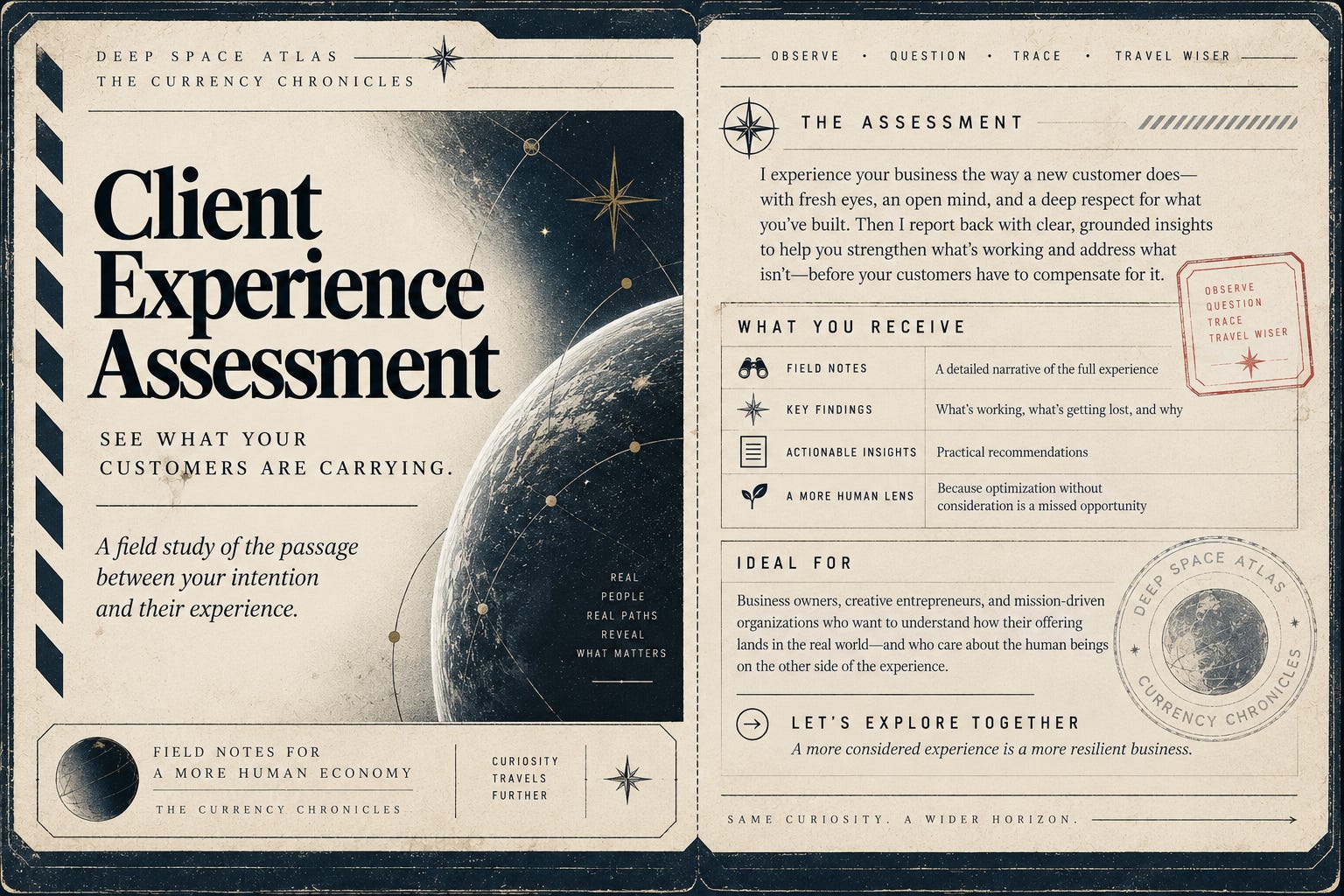
At some point it occurred to me that this might actually be useful to someone else.
For now, I’m calling it the Client Experience Assessment.
The premise is somewhat unusual: A business commissions me to become its customer.
I enter without first being taught how everything is supposed to work—before familiarity teaches me how to compensate for any of it.
Then I report back.
Where did I have to compensate for something the business hadn’t made clear?
Where did intention and experience diverge?
And what is already working so beautifully that I wouldn’t touch it?
Because optimization is not automatically improvement.
Sometimes the strange, inefficient, handmade or generous little thing someone is preparing to eliminate is precisely the thing making the experience human.
There is also something unusually valuable about arriving only once.
A first encounter is a perishable kind of information. Once someone explains where to stand, which door to use, what the language means, why the sign is wrong, how the process works or why “we’ve always done it this way,” I cannot completely unknow it.
The businesses appearing in my public field notes remain anonymous because they haven’t commissioned an assessment. Those stories demonstrate how I pay attention, what the encounters teach me, and are not intended to parade public critiques for dramatic effect.
The findings belong to the business that commissions them.
I suspect some of the most expensive problems in our economy are hiding inside the difference between a business that works—
and a business that works for the human being inside it.
Field Notes
Dominant Question
Who is doing the work required for this experience to work?
Gift Carried Forward
The recognition that consideration can be designed before a person ever arrives.
Shadow Left Behind
The assumption that a successful transaction proves a successful experience.
Present-Day Echoes
Where are costs being transferred simply because they are difficult to measure?
Contemporary Sightings
You may encounter this exchange today in:
• Restaurants and retail
• Workshops and events
• Coaching and consulting
• Healthcare and wellness
• Hospitality and tourism
• Digital platforms and subscription services
• Any system where the customer quietly learns how to compensate for the system
Continue Your Travels
Expedition 01
Client Experience Assessment