

Current Exchange Rate
Highly Valued
Self-authority
Discernment
Creative agency
Commercial intelligence
Reciprocal exchange
Frequently Extracted
Financial confidence
Interpretive authority
Emotional labor
Creative capacity
Future earnings
Local Customs
Travellers entering this territory may notice:
Financial hesitation is frequently interpreted as fear.
Psychological insight can become a prerequisite for commercial participation.
The seller may profit regardless of whether the buyer achieves the promised outcome.
Personal worth and market demand are often mistaken for the same thing.
The cost of learning to earn can exceed the earnings themselves.
A successful transaction does not establish that the customer needed what was sold.
Border Advisory
This territory is particularly hazardous to travellers who have mistaken their willingness to grow for evidence that they require repair. You may encounter persuasive invitations to invest in your future, overcome scarcity, and become the person capable of receiving what you desire.
Before surrendering your currency, examine the terms.
Sometimes the person interpreting your resistance has a financial interest in overcoming it.
Observation Log
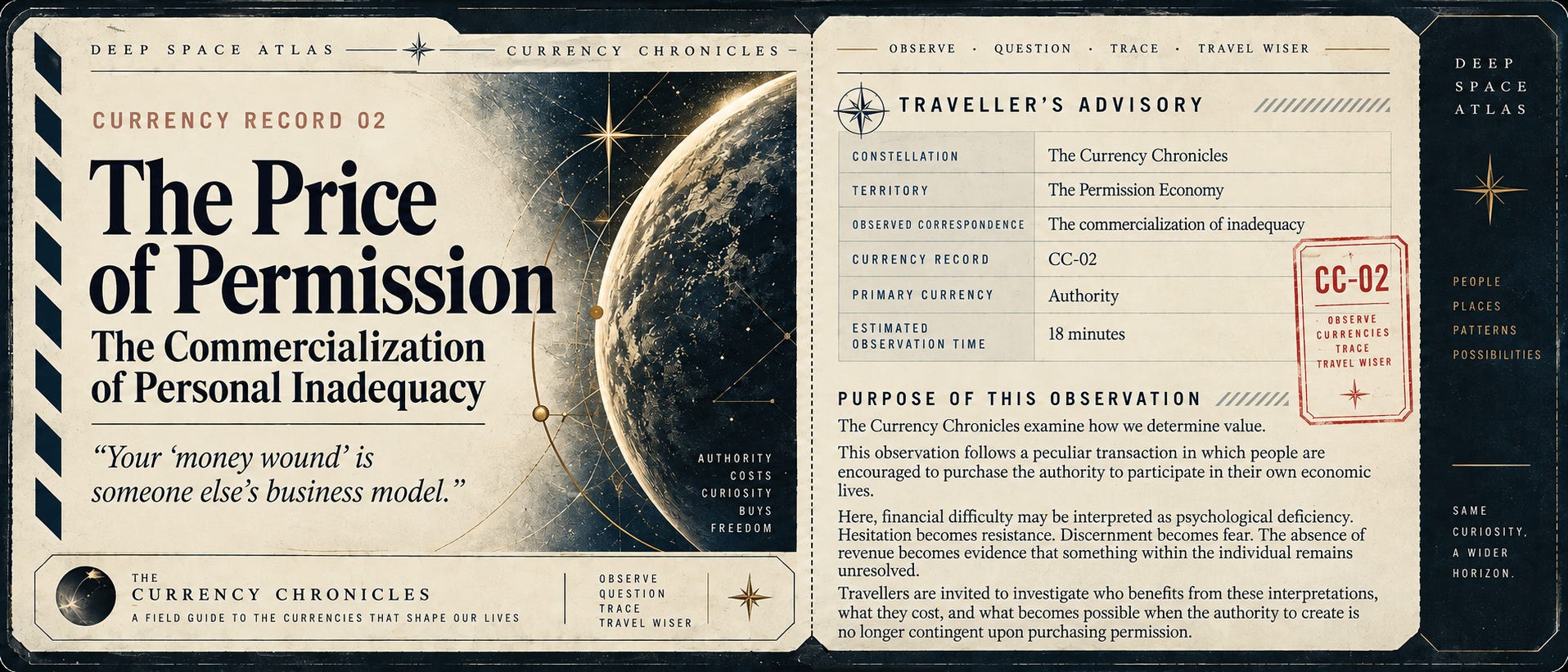
The Price of Permission
They told us it was a money wound.
They told us, your money wound is connected to your father wound is connected to your worthiness is connected to your value is connected to your hip bone is connected to your thigh bone… you get the picture.
We were told that beneath our inability to earn what we wanted was a fundamental belief that we didn’t deserve it. That our businesses weren’t growing because we hadn’t learned to receive. That our prices were too low because we didn’t know our worth. That we were afraid of success, secretly committed to scarcity, or carrying some ancestral inheritance of financial shame.
And wouldn’t you know it? There was a program for that.
A coach. A mastermind. A nervous system reset. A six-month container with a payment plan.
We could pay someone to help us discover why we weren’t making enough money. Apparently, the first step toward financial liberation was another financial obligation.
How convenient.
The Business of Being Broken
I have grown increasingly skeptical of industries that require people to believe something is wrong with them before they can participate successfully. Or where the business is contingent on someone having “a problem” in the first place.
Particularly when the people making the diagnosis also happen to sell the treatment. And worse: those who buy are, more often than not, interested in preserving their own integrity, willingly accept accountability, and truly desire to take control of the results they are vested in.
The money wound is a marvelous little invention for this purpose. It is difficult to disprove, infinitely expandable, and sufficiently intimate that questioning it can be interpreted as further evidence of its existence.
You resist the price? Scarcity mindset.
You question the methodology? Trust issues.
You can’t afford the program? A receiving block.
You complete the program and your financial circumstances remain unchanged? There’s another layer to uncover.
The diagnosis survives every outcome.
Meanwhile, the practitioner gets paid.
I am not suggesting that our experiences with money have no psychological dimension. Of course they do. Money touches survival, identity, family, power, belonging, and the very real consequences of having too little of it. But somewhere along the way, an entire commercial language emerged that treats financial difficulty as evidence of an insufficiently healed person.
As though the market were a benevolent spiritual examiner, distributing revenue according to emotional maturity.
Have you met the people running this world?
Some of the wealthiest, most financially successful people on the planet are profoundly troubled individuals. Their businesses do not stop producing revenue because they have unresolved childhood experiences, dysfunctional relationships, or questionable motives.
In some cases, their dysfunction is part of what makes their business so profitable.
Martyrdom can be monetized. Insecurity can be monetized. Outrage, dependency, manufactured intimacy, and the perpetual promise of transformation can all be monetized.
Money has never required its agents to be healed.
It requires an exchange that someone is willing and able to make, within a structure capable of collecting payment.
So why are we telling people they must become psychologically worthy before they can earn it? And again, who’s deciding on the standard?
The Labor We Outsource to Ourselves
In The Labor We Outsource to the Customer, I explored the increasingly common practice of transferring the labor of a business onto the person purchasing its products and services.
The customer becomes responsible for navigating the system, resolving the friction, interpreting the instructions, and absorbing the consequences when something fails.
Now consider what happens when the product is personal transformation:
The cost to the customer “doubles.” Now, the customer is responsible for purchasing the program, implementing the methodology, regulating their expectations, maintaining their belief, overcoming their resistance, and producing the promised outcome.
If the outcome fails to materialize, the business has a ready explanation.
✔️ The customer wasn’t ready.
✔️ Didn’t do the work.
✔️ Wasn’t sufficiently committed.
✔️ Still had a wound.
A remarkable arrangement, really. The business can collect revenue while assigning responsibility for the result almost entirely on the person who paid.
And because the customer has been taught to interpret their difficulties as evidence of personal inadequacy, they may never think to question the transaction itself.
Instead, they purchase another explanation.
This is how the labor of becoming financially successful can be converted into a recurring expense, with no guarantee that the purchased expertise addresses the actual problem.
Perhaps the offer is poorly positioned.
Perhaps the intended customer has no interest in buying it.
Perhaps the business has no effective distribution.
Perhaps the cost of acquiring customers exceeds the revenue those customers produce.
Perhaps the economy is difficult, the timing is wrong, or the entrepreneur is attempting to sustain an enterprise that requires more labor than one body can reasonably provide.
These are ordinary business questions. And all of them are pointing to a wound you “already possess,” on the premise that your inner child is running the show just below your awareness at all times.
What about the power you hold that no one else can see because they’re too busy reducing you to your wounds? And who decides it’s a fault, anyway?
What Does It Cost to Make Money?
Have you ever noticed what happens when you begin organizing your life around a financial goal?
Suddenly, the pursuit of money begins requiring money.
You need a website. A platform. A brand. Software subscriptions. Professional photographs. A sales funnel. Better equipment. Marketing support. A payment processor. A business mentor who can help you afford the business mentor.
Then there’s the labor.
The hours spent learning how to sell, packaging what you know, translating your instincts into deliverables, and convincing strangers that the thing you have created is worth purchasing.
Some of these investments are necessary. Some are useful. Others exist because we have inherited an increasingly elaborate picture of what a legitimate business is supposed to look like.
And somewhere inside that picture, we begin losing sight of the original activity that made us want to participate.
The writing.
The conversation.
The art.
The gathering.
The peculiar pleasure of discovering something useful and placing it into the world.
What began as an expression of intelligence becomes an administrative operation designed to finance its own continuation.
This is where I begin asking a different question.
Not simply how much money an activity generates.
What does it cost the organism to generate it?
What happens to the body when every creative impulse must justify itself through a financial projection?
What happens to curiosity when it is required to become an offer?
What happens to relationships when every encounter becomes a possible customer acquisition?
And what happens to the quality of our work when we spend more energy manufacturing demand than practicing the thing we actually do?
There are businesses whose financial success depends upon these arrangements.
But there are also people whose most valuable contributions emerge under entirely different conditions.
Which brings us to the rather inconvenient possibility that the method we have been taught to use to make money may be consuming the very intelligence we hoped to monetize.
The Currency We Were Already Producing
I have experienced wealth in arrangements that would look positively absurd on a conventional business plan.
An exchange of care that becomes access to a beautiful place.
Travel that introduces new relationships, invitations, opportunities, and sometimes compensation.
A conversation that produces a collaboration neither participant could have predicted.
Even bankruptcy can reveal something about the distinction between money and wealth. A financial structure can collapse without extinguishing the intelligence, relationships, abilities, and future possibilities of the person who once occupied it.
None of this makes financial obligations imaginary.
Bills still arrive. Resources still have costs. Money remains a remarkably useful medium of exchange.
I am interested in something more expansive than pretending otherwise.
I want to understand the currencies we generate before anyone assigns them a price.
Attention. Trust. Skill. Imagination. Access. Hospitality. Discernment. Relationship. Time.
Not every one of these currencies should be monetized. Not every exchange requires a sale. And not every contribution needs to be translated into a number to become consequential.
Our bodies participate in economies long before we open a bank account.
They produce intelligence through sensation, movement, memory, perception, and interaction with their environments.
They recognize opportunities that may not yet have a market category.
They form relationships whose value cannot be forecast.
They create because something has captured their interest, not because a payment has been authorized.
And I wonder how much of that intelligence becomes inaccessible when we insist that money must arrive before we permit ourselves to use it.
How much of our creative capacity is spent negotiating permission to create?
The $400 Walk in the Park: A Thought Experiment
Suppose I decide that spending an afternoon walking through the woods with me is worth $400.
I believe in the value of my presence. I know the quality of my attention. I understand what can happen when two people enter a conversation without distraction.
Wonderful.
But my belief does not create a customer.
Someone must want that experience, recognize its value, have the means to purchase it, and consider the exchange worthwhile.
I can spend months convincing myself that I deserve $400 for a walk in the park.
I can pay someone to help me feel confident charging it.
I can design an exquisite sales page, build a payment portal, and announce that anyone who hesitates simply isn’t ready to invest in themselves.
And after all that effort, I may have constructed a remarkably expensive way to take a walk.
Or I could discover that the people who value my presence most are interested in an entirely different arrangement.
Perhaps they want me to visit their business and observe how it operates.
Perhaps they want to host me for several days while we investigate a project.
Perhaps they have resources, relationships, or opportunities that make a different kind of exchange possible.
Perhaps the walk is simply a walk, and the actual paid engagement emerges elsewhere.
The question was never whether I was worthy of receiving $400.
The question was whether the proposed exchange made sense.
And no amount of psychological healing can relieve us of the responsibility to investigate that.
This does not mean abandoning monetary compensation.
Quite the opposite.
It means becoming more precise about what we sell, what we give, what we exchange, and what we refuse to surrender.
A business still needs revenue. A person still needs material support. Generosity without boundaries can become another form of extraction.
But none of these requirements establish money as the supreme authority over the conditions of creation.
The Price of Permission
Here is the contract I believe many of us have been sold:
First, accept that your inability to produce the desired financial outcome reflects something unresolved within you.
Second, purchase the expertise necessary to identify and repair that unresolved condition.
Third, adopt a model of business that translates your gifts into sufficiently marketable products.
Fourth, continue investing until the model produces the promised financial result.
And if it doesn’t?
Return to the beginning.
There is always another wound.
Another block.
Another version of yourself who must be constructed before you can finally participate.
I find this arrangement revolting.
Particularly because it is so often sold to people who are already struggling to afford the lives they want to live.
People who have been told that their desire for freedom is evidence of their potential, only to discover that freedom apparently requires an endless series of paid initiations.
People whose creativity has become collateral for somebody else’s revenue model.
People who have mistaken a lack of commercial traction for a defect in their character.
I want to ask them something.
What would you create if money were no longer responsible for giving you permission?
Not what would you give away.
Not how would you survive without getting paid.
Not how could you pretend your material needs no longer exist.
What would you actually make?
Who would you spend time with?
Where would you go?
What would you investigate?
What might become possible if you stopped forcing every expression of your intelligence through the same commercial doorway?
And once you could see those possibilities clearly, which of them would you deliberately build a business around?
Because the purpose of discovering your personal currencies is not to escape the monetary economy.
It is to enter that economy with a better understanding of what you possess, what you produce, and what participation actually costs.
The Queen’s Gambit: Chess Economics
In chess, the most valuable piece is not necessarily the one that captures the most pieces.
Its value depends upon its position, its available movements, the relationships between pieces, and the possibilities those relationships create.
A powerful piece in the wrong position may accomplish very little.
A seemingly insignificant move may alter the entire board.
I think wealth behaves similarly.
We have been taught to count what we accumulate, while paying considerably less attention to where we stand.
What opportunities become available through our relationships?
What forms of work are unusually natural to us?
Where does our presence create value without requiring extraordinary force?
Which exchanges strengthen our capacity to participate again tomorrow?
And which opportunities, however lucrative, demand a price we are unwilling to pay?
There are people who will earn extraordinary amounts of money by making compromises I have no interest in making.
Good for their bank accounts.
But I refuse to interpret my unwillingness to occupy those positions as evidence that I am wounded.
Sometimes the difference between two people’s earnings is market access. Sometimes it is capital, timing, luck, or skill.
And sometimes it is the price one person is willing to pay that another is not.
Exploring that distinction does not require a diagnosis.
A Different Contract
I believe money belongs in the hands of people with extraordinary imagination, sound judgment, and the desire to make something useful of their resources.
I also believe those people should be paid well.
Not because they have finally healed enough to deserve it.
Because they can participate in valuable exchanges, negotiate favorable terms, build viable enterprises, and create conditions in which their work can continue.
That requires commercial intelligence.
It requires understanding the difference between an audience and a customer, an invitation and an offer, generosity and obligation, revenue and wealth.
It requires knowing when to charge, when to exchange, when to give, and when to walk away.
It may also require examining our relationship with money. There is nothing inherently wrong with that inquiry.
But we can investigate our patterns without assuming that every financial obstacle originates in the “original sin” of psychological damage.
And we can develop our capacity to earn without purchasing permission to exist as we already are.
You do not carry money wounds any stronger, by definition, than the people who run this world.
Your financial circumstances are not a reliable measure of your character.
And your body does not need to be declared sufficiently healed before its intelligence becomes useful.
So before you buy another program promising to repair your ability to receive, I would encourage you to investigate what you are already producing.
What moves through your life?
What do people seek you out for?
Which exchanges leave you more resourced, and which ones leave you depleted?
Where is your intelligence already creating value?
And who, exactly, is getting paid for it?
Perhaps the most expensive thing you have ever purchased is the belief that someone else must authorize your participation.
Your money wound is someone else’s business model.
You are allowed to stop buying it.
If you’re interested in investigating your personal currencies, the exchanges already operating in your life, and how to build an economy that supports rather than consumes your creative capacity, let’s talk.
There is more than one way to become wealthy. And not every valuable move begins with money.
Field Notes
Dominant Question
Who benefits when financial difficulty is interpreted as a defect in the individual rather than a condition worthy of investigation?
Gift Carried Forward
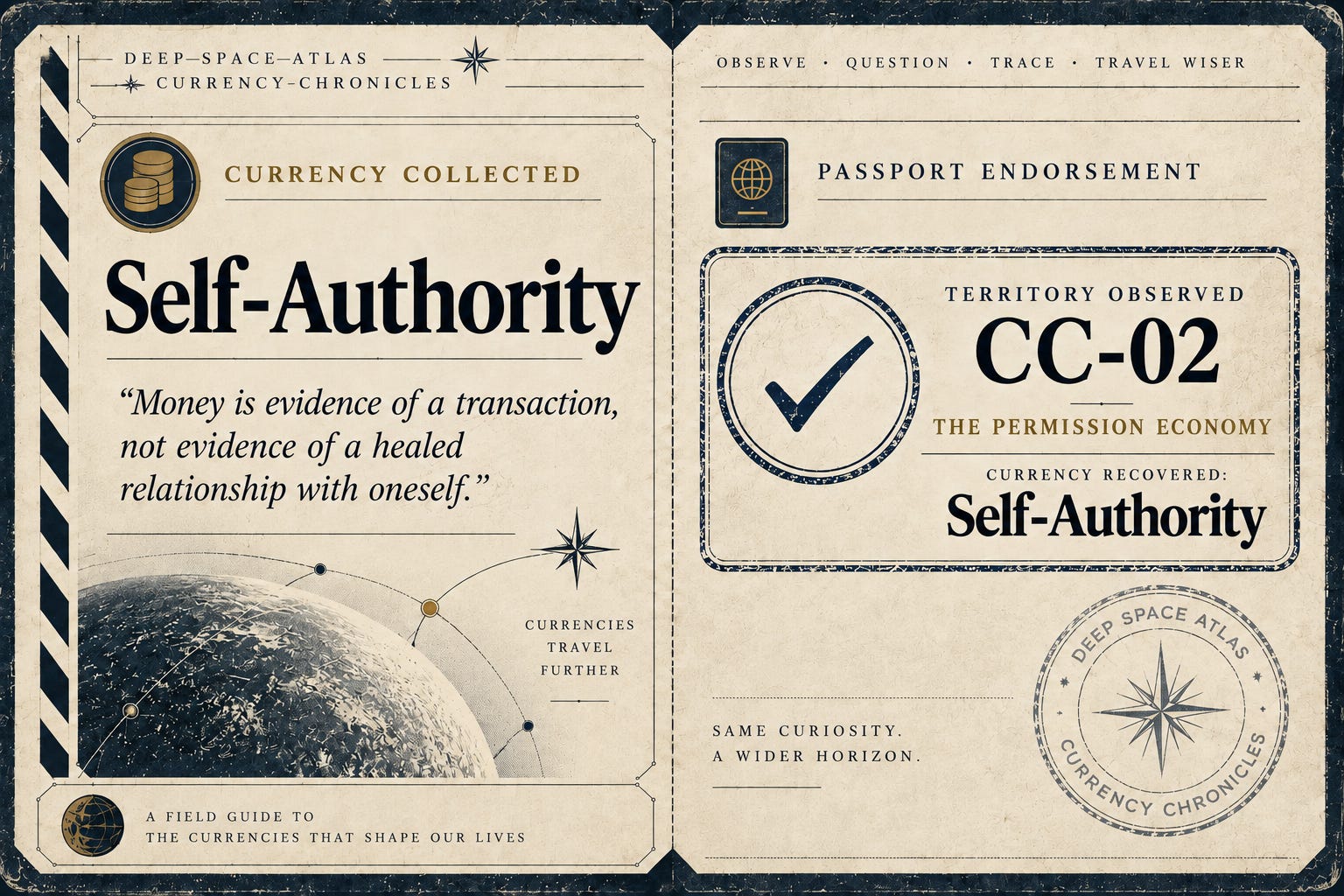
The authority to investigate our own currencies, negotiate our participation, and determine which exchanges deserve our resources.
Shadow Left Behind
The belief that financial success is evidence of personal healing, or that financial difficulty reveals a deficiency of character.
Present-Day Echoes
Where have we confused the cost of becoming commercially legible with the actual value of what we produce?
Contemporary Sightings
You may encounter this valuation model today in:
• High-ticket coaching and mastermind programs
• Financial manifestation and abundance courses
• Personal development sales funnels
• Business mentorship and certification programs
• Spiritual entrepreneurship communities
• Premium wellness and transformation services
• Any commercial environment where questioning the purchase is treated as evidence that the purchase is necessary
Continue Your Travels
RETURN TO THE PREVIOUS TERRITORY:

The distance between what we meant to give and what someone actually received.
INVESTIGATE YOUR OWN CURRENCY PORTFOLIO:

What are you already producing that the monetary economy has taught you to overlook?
Where is value accumulating? Where is it being extracted? Which exchanges support the continuation of your work, and which require you to spend more than you receive?
If you’re interested in investigating the personal currencies already circulating through your life, let’s talk.
The expedition begins with what you already possess.